Sunday, July 3, 2011

Kitchen Experiments : Chhole Paratha, or how to convert leftovers from a North Indian dinner into a delicious take-away breakfast


Today, after many years, Mom made Chhole - the North Indian (don't know if its strictly Punjabi) dish of chickpeas redolent with tomatoes, onion and fragrant spices. Studded with soft cubes of paneer, Mom's version is finger-licking, plate-wiping good, though I have no clue about how authentic it is. :)


Being Sunday, I had some free time to mess around in the kitchen - and in a happy coincidence, I got a lighting bolt (no, make that two bolts) of culinary inventiveness, so off I started.

First off was Chhole Paratha:

Kneaded wheat flour (atta) and refined/superfine wheat flour (maida) (roughly in the ratio 2:1) and kneaded it with oil, salt and water to make a soft dough.


Mashed the pre-made chhole (leftover from lunch) and crumbled in a boiled potato to the mix. Adjusted the seasoning (salt, green chilly paste and garam masala) to make up for the added volume of the bland potato.


Rolled out a thin (a shade thicker than normal phulka) roti, spread out the mashed chickpea-and-potato mix, and folded the roti over the stuffing to make a neat rectangular parcel.


Cooked the paratha parcel in a frying pan with ghee to help things become all golden brown and sizzling. :)


Served piping hot off the tawa with a dollop of sweet-sour-spicy chutney (mint-coriander-raw mango-jaggery)


Preened as Mom and Dad dug in with gusto. :D


Yay!


The advantages of this technique (can't really call it a recipe) are:
  • It transmogrifies leftover heavy curries/gravy dishes into a whole new dish, and make them more appealing/palatable - often I have noticed that I cannot face the spicy dishes I relish at lunch/dinner when they are served at the next meal as leftovers - especially if they have been made in large quantities like for a party.
  • It is versatile - you can convert not just chhole, but any other spicy gravy dish (navratan korma, palak paneer, chana masala, and so on) into paratha stuffing when you blend in enough mashed potato/paneer
  • You cant eat subzi-roti for breakfast, can you - but parathas go down a treat!
  • Packing leftover subzi-roti as an office/school lunch can be a task (water-tight container for the subzi/curry, foil for the roti, spoon to eat the curry with) - a paratha is finger-food if made into a roll wrapped with foil - so much more convenient to eat!
Another technique that Mom suggested was to mash the leftovers of the gravy dish, add oil and wheat flour - keep adding flour till a knead-able dough is formed - roll out the spiced dough into a roti and roast with some ghee in a frying pan. So you are spared the multi-step process of stuffing the paratha, and can make parathas similar to the Gujarati thepla.

So go ahead, make your own paratha mutants...err....I mean variants (:P) And comment on this post with your own recipes!

Sunday, June 26, 2011

Cookery School : True-blue Chicken Biryani


Quite a few weeks ago (yeah, I am not the most prompt of bloggers!), one of our colleagues at work, Allie (or Mother Goose Allie, her being very mature and maternal toward the rest of us immature overgrown kids) was gracious enough to teach us her speciality - chicken biryani. The time was a lazy rainy Saturday afternoon after work, and the venue was, like for all cookouts, Agent J's bachelor pad.

This was the Real McCoy of biryanis - made in the authentic Muslim style and not a Punjabi/Udipi reinvention. The day before the cookathon saw us prepping for the big day - we shopped and marinated the chicken overnight in the fridge. This cut down on the cooking time considerably and let us sit down to an enormous - no, ginormous - lunch at the fashionably late hour of 4:00 PM (the travails of working half-day on Saturdays, I tell you...)

Imagine this ....pouring rain, overcast skies and a cold breeze outside the window ..... and inside, gently uncurling wafts of chicken-scented steam, a BIG pot of DELICIOUS piping-hot biryani and the most congenial company you can wish for. What a way to spend a gloomy rainy Saturday!

Biryani is the ultimate party dish - its taste is a sure-fire crowd-pleaser, it tastes best when made in a large quantity, just one dish on the menu generally suffices when that dish is biryani (if you can order in some dessert), AND there's an element of drama in uncovering the big pot of rice for that first waft of chicken, basmati rice and spices.

So round up your friends, cook up a big pot of biryani and have a great time!

Here is Allie's recipe for amazing chicken biryani:

Ingredients:

For the marinade:

1.5 tablespoons ginger paste

1.5 tablespoons garlic paste
1.5 tablespoons green chilly paste
400 gms thick yoghurt / curds
1.5 tablepsoons Kashmiri red chilli powder

1.5 tablepsoons garam masala (powder)
1 teaspoon turmeric powder

salt, to taste


2 whole chickens, cleaned and cut in approximately 10 pieces each (dont' use offal meat like livers/hearts tec)

1/2 kg potatoes, peeled and halved
1/2 kg birasta or deep-fried onion slices (1/2 kg after frying - if you dont get the readymade version, you'll have the painstaking job of thinly slicing 1 kilo of onions and deep frying them in oil till really crisp - track down the readymade version at Muslim caterers/grocers)
Khada (whole) garam masala - mix of 2-3 cloves, 2-3 cardamom pods, 1 inch stick cinnamon, 3-4 black peppercorns, 1/2 teaspoon coriander seeds
(dhaniya), 1/2 teaspoon cumin seeds (jeera), 2-3 bay leaves
two handfuls mint (pudina) leaves

2 handfuls coriander leaves, chopped

1 kg Basmati rice

Lots of oil - for frying the potatoes and cooking the chicken

2-3 small tomatoes, chopped
salt, to taste

1 big pinch saffron (kesar) dissolved in 2 tablespoons warm milk - optional

3 tablespoons ghee - optional


Method:

Clean the chicken pieces thoroughly, and score cuts on the pieces for the marinade to penetrate inside.

In a BIG vessel, dump in the chicken pieces and add the ingredients of the marinade.
Crush in one-third of the fried onions as well.
Mix well, using your
hands and rub in the marinade into the pieces of chicken.
Taste the marinade- it should be slightly saltier and spicier than is normal. Adjust the seasoning if required.


Cover the vessel with a lid, and refrigerate overnight or for at least 2-3 hours. Overnight is better.

Cook the basmati rice with 2 bay leaves and 2-3 teaspoons of oil in more than the usual amount of water (normally we use twice as much water as rice).

Once the rice is half-cooked, drain away the excess water. This process of par-boiling ensures that the grains of rice stand separate and not clump together
in one sticky mass.


Fill a frying pan to upto 2 inches with oil. Put it on the stove till the oil gets hot.

Add the potato halves and fry till lightly golden and dark golden-brown around the edges.
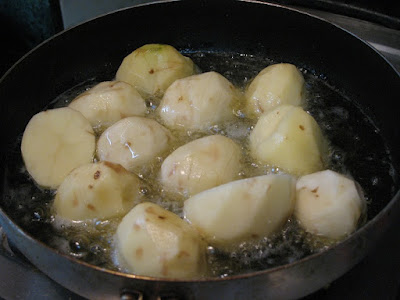


Take the potatoes out, drain on tissue paper.

In a big (the biggest you can find) vessel/pot, add the 5 tablespoons oil.
Add the khada garam masala and saute for 2-3 minutes.

Add the tomatoes and stir till the tomatoes are softened
.


Add the marinated chicken pieces along with all the marinade and give it a good stir. Keep stirring every 10-15 seconds or so else the chicken will stick to the bottom of the pot.
Add another one-third of the fried onions (crush them lightly before adding them to the pot).


Add the fried potatoes and stir well.
Cook for 10-15 minutes, stirring regularly. till the chicken is 3/4ths cooked.


Take off the stove, and divide the cooked chicken and potatoes into 2 (or 3) large pots/handis. This mixture should take up a little more than one-third of the
volume of the pot.

Fill the pots till the top with the cooked rice.


Sprinkle mint leaves and the last one-third of the fried onions on top of the rice.
If you wish, you can add a swirl of the saffron-in-milk and a few spoons of ghee as well.


Cover the pot with a lid that is secure (not too many gaps for the steam to escape)

Switch on the stove, put a tava (griddle) on the flame. This spreads the heat over a larger area rather than the concentrated flame of the stove.
Load the pot of rice and chicken onto the griddle, let it cook for a further 20-25 minutes on a low flame.

A glorious bouquet of aromas - spicy chicken,
delicate Basmati, ghee, mint, kesar (if you have added it) shall waft your way once the biryani is ready.

Take the pot off the stove, and serve - the almost-plain rice (from the top of the pot) in one large communal plate and the spicy chicken-and-potato mix (from the bottom of the pot) in another. When you make biryani in such a large pot, there's no way you can combine both the layers in one single serving. :)

People can help themselves in their individual plates from both these communal plates, and eat and eat and eat.

Food heaven, here we come!

Thursday, June 9, 2011

Quick-fix meals : My Own Chicken Fried Rice

The testimony to this recipe being really quick (and really easy) is the fact that there are no photos of work in progress while making it.

Confused?

Flash back to yesterday morning when I woke up bleary-eyed after a late night at work. The words that greeted me were not "Rise and shine! Here's some freshly-squeezed orange juice for you!" but, "There's some rice left over from dinner, and I have got out those mini chicken sausages from the freezer. You can make fried rice for your lunch if you wish."

The faintest glimmer of an idea flickered to life in my sleeeeeeepy brain and I dragged myself to the kitchen to put it into action. So sleepy was I that I didn't even bother taking any photos as the dish took shape, even after it started looking rather promising. Now, any dish which gets invented and executed in such a state of sleep deprivation and energyless-ness HAS TO, by necessity, be quick and simple, right? :)

I had not the slightest plan to feature SUCH a quick-fix recipe on the blog - but the rave reviews this dish got at lunch time from my foodie colleagues made it imperative that I document it! So here it is is, in all its glory:

My Own Chicken Fried Rice

Ingredients:

2 cups cooked rice - fluffed out with a fork
5-6 mini chicken sausages (cocktail sausages) - I used tandoori flavoured ones, but any spicy normal-sized sausage/leftover kebab will do.
1 egg
1 small onion, chopped fine
1 clove garlic, minced
1/2 a capsicum, chopped the same size as the onion
1-2 green chillies, chopped (optional)
chilli sauce, vinegar (optional), salt - to taste
1 tbsp oil


Method:

Heat half the oil in a frying pan, and add the sausages (don't bother thawing them completely) While they are being fried, you can chop the onion, garlic, chilli and capsicum.

Once the sausages look golden-brown and start splitting at their sides, pull them out of the pan. Add the rest of the oil to the sausage-flavoured oil+juices in the pan, bring the heat up, and add the onion, garlic and green chilli. Stir for a minute.

Add the capsicum, and stir for a couple of minutes

Add the vinegar, salt and chilli sauce. I used Nando's Peri Peri sauce which was hot-and-sour so I didn't use vinegar.

Break open one egg, and stir the contents in the pan till the egg has scrambled

Add the rice. Give it a just one or two brisk stirs, don't keep mixing the rice once its in, else the grains will break (cooked rice is fragile!)

Slice the sausages into bite-sized chunks. Add to the rice, give it one final mix-through, taste, adjust the seasoning and turn off the flame.

The rice will improve in flavour in a few hours' time - the egg, sausage and chilli needs time to permeate the rice and make it delicious. So it is an ideal lunch box dish that you whip up in the morning but eat it hours later at lunch time!

Sunday, June 5, 2011

Rainy Evening Nirvana : Batata Wada Reinvented!


Its been raining on and off - more on than off, I am glad to report - in Mumbai since the last few days. Its heart-achingly beautiful weather - dark grey skies, soft, soft drizzles, wispy misty clouds - all of them making the perfect backdrop for the fiery brilliance of the of the Gulmohar in full bloom.

And what better way to improve perfection than piping-hot Batata Wadas, strong sweet adrak chai (tea brewed with ginger) and comfortingly sweet mango sheera? :) That was the menu of a recent Sunday evening spent in the company of extended family and Marathi golden oldies on the stereo.

Though Dad is a Batata Wada fanatic, I am more partial to Mom's reinvention of the BW.

The Classic Maharashtrian Batata Wada


Mom's Batata Wada Bhajis

While the classic Batata Wada consists of a ball of spicy mashed potato dipped in chickpea batter and deep fried, Mom's Batata Wada Bhajis up the ante on the crunchiness index, with the spiced potato mash mixed right into the batter to make a homogenous mess and deep fried to get crisy, crunchy golden morsels.

Apart from the higher cruchy batter-to-soft filling ratio as compared to the BW, these bhajis (fritters) are also easier to make and less labour- and time-intensive. No making balls of the filling-dipping them in batter to get an even coating-frying them in small batches, just mix the spicy potato mash into the batter, and drop bite-sized clumps into the hot oil. Fry large batches at a time - and eat piping hot with sour-spicy-sweet mint-and-raw mango chutney. With a cup of Mom's special tea, it cant get any better!

Mom's Batata Wada Bhajis

Ingredients:
2-3 large boiled potatoes, peeled and coarsely mashed
1 large onion (red), chopped finely


3-4 fat cloves of garlic, chopped fine/minced

1/2 inch piece ginger, chopped finely

2-3 (as many as you like) green chillies, chopped medium-fine

(Alternatively you can replace the above three by 1 tbsp ginger-garlic-green chilli paste)


A handful of coriander leaves, chopped

salt and sugar and lemon juice - to taste


1 cup chickpea flour (besan)

salt, red chilli powder, turneric powder - a pinch each

1 tbsp oil - heated till near-smoking point

water

Oil for deep frying


Method:

Mix the potatoes, onion, ginger, garlic, chillies, lemon juice, salt and sugar. Taste and adjust seasoning - it should be a tad saltier/hotter than the ideal, since it has to
season the batter as well.

Mix the hot oil, chickpea flour, salt, turmeric, red chilli powder and water to make a thick batter. Some peopl use soda bi carb to make the batter light and crunchy, but,
apart from it being not good for you, it is unnecessary as well.

Heat the oil for deep-frying in a large kadhai (wok) till really hot. Test-fry a tiny amount of batter - the oil should start spluttering and bubbling around the batter.


Mix the potatoes mix into the batter and stir well to incorporate the two evenly.

Drop small clumps (teaspoon-sized) of this mix into the oil. They HAVE TO be small in size
since the batter has to be cooked through all the way. If you make really large dumplings, the batter on the outside will be burnt to cinderblock by the time the batter at the centre of the fritter is cooked completely.

Deep-fry till golden brown in colour


The hand that fries the bhajis rules the world. :P

Golden perfection!

Serve sizzling-hot with tangy mint-and-raw mango chutney, a cup of steaming tea to the background music of pitter-patter rain.

Nirvana is not elusive after all. :)

Monday, April 4, 2011

Quick-Fix Meals : Patra Ni Macchi


Patra Ni Macchi (henceforth shortened to PNM) is one of the brand ambassadors of Parsi cuisine, mentioned in the same breath as Dhansak. A popular staple of the lagan nu bhonu (the traditional Parsi wedding menu), I see it going on to achieve even greater fame and popularity than the famed Dhansak - because of its simple, quick recipe which calls for minimal ingredients and its high score on the "healthy eating" quotient.

Traditionally PNM is made using pomfret - delicate fillets sliced from large pomfret. But for that you need large fish ,which can yield sizeable fillets when hacked. An alternative is to use the whole fish rather than fillets - which I was not too keen on, since pomfret has small bones which a fish eating novice like me cant deal with. Also, this being the first time I cooked fish of any kind, I wanted to use my favourite fish, i.e. surmai or kingfish as a good omen. :) So off I went on the non traditional route - and am very happy and proud to say that the improvisation worked - oh it worked damn well!

The recipe is extremely simple and you can get it on at least a dozen websites, and I browsed through a few to confirm the ingredients which I had culled from memories of eating PNM at the several Parsi Navjotes and weddings I attended as a child. Many of these recipes mentioned surmai or raavas (Indian salmon) as alternatives to pomfret, and I was reassured about my choice!

Needless to say, I didnt follow any recipe to the T - a result of my culinary instinct and a lack of some ingredients. :P All the recipes that I checked called for cumin (jeera) to be added to the paste, and a much smaller proportion of mint leaves to coriander leaves. But jeera was not to be found and my inner cook dictated that I use mint generously, so there you are. :)

You MUST eat this dish piping hot - there are fewer pleasures than unwrapping the leaf-parcel of fish and breathing in moist steam, laden with heady aroma of mint and coriander and fish.


The fish is moist, perfectly cooked (flakes at the touch of a fork, yet has a meatiness to it) and is very fresh and flavoursome - so tasty that it converted two non fish eaters in our dinner group to avid fish fans. Need I say more? :)

Here's my take on the recipe:

Ingredients:
7 plump (3/4ths of an inch thick) steaks of surmai

2 tight fistfuls of coriander leaves and tender stalks (yeah, I am an ace at giving accurate measures!)

1.5 tight fistfuls of mint leaves

2 fistfuls (not too tightly packed) of fresh grated coconut
6 green chillies (but the quantity will vary depending on the heat of the chillies)

6 cloves garlic- peeled and chopped
1 inch slender piece of ginger , or 0.75 inches of a fat one - chopped

Salt to taste

Juice of 1.5 lemons

Turmeric powder - 1 tsp

2 large banana leaves - if you cant get them from your garden (like I did), try getting them at the flower market. Else use foil, but then the dish should be called Foil Ni Macchi. :)

Method:

Wash the banana leaves and dry them. Cut each large leaf into four square-ish pieces.


Wash the fish and pat dry. Sprinkle some turmeric powder and salt on both sides of the steaks and gently rub it in. Leave aside to marinate for 10-15 minutes.


Blend the mint, coriander, coconut, chillies, lemon, ginger, garlic and salt (remember that the fish has salt on it - so use salt accordingly) to a fine paste in a mixer. Add
water sparingly to make a thick paste. (We dont want a runny marinade, the fish gives off its moisture as it cooks anyway, and too much moisture means mushy fish - yuck!)

Pat on the paste to form a thin layer onto both sides of the steaks. Work carefully, precisely - the paste has to just-cover the fish, it is NOT a marinade to be just rubbed into
the fish and left as a mess in the bowl.


Wrap each steak in one leaf-square, fold over to completely cover the fish. The leaves need to be cut generously so that you have ample room to fold the leaves over the fish.


Place the leaf-wrapped fish (folds-side-down) onto a steamer (with lid on) and steam for 20 minutes. But the cooking time will vary according to the type of fish used and the
thickness of the steak, so start testing the fish for done-ness at 15 minutes or so. (Handy hint - to check for the fish being cooked, pierce a toothpick into the fish through the leaf. If it goes through without any resistance whatsoever, the fish is cooked. Raw fish will offer resistance due to its jelly-like membranous texture)

Remove from steamer, serve the parcels as they are to people - it is awesome to unwrap the fish at the table - like an edible gift. :P


Serve lemon quarters on the side, for people to spritz on, if they so desire.

Enjoy piping hot!

 
Web Analytics